Check out this article from the Wall Street Journal: Price Drop: Stocks, Homes, Now Triple-Word Scores. The subtitle “Scrabble and Other Games — on Boards, Fields, Courts and Ice — Have Overvalued Points; Vermont Avenue Is a Steal” sums it up pretty well. This article illustrates the difficulty of designing a game that is fair, challenging and interesting to players of all levels, and maintaining those qualities as time marches on and the world and the players change around you. If your game becomes genuinely popular and “professional players” appear, they will begin to exploit any flaws in your rules, and then you must either change the rules or accept these exploits as part of the game.
Abstract Scrabble and threeandthrees
A couple weeks ago ALASSCA had a meeting! By “meeting” I mean Adam and I hung out at his house and played some games, but we had fun and I would like to share some of that fun with you.
Abstract Scrabble
Adam invented this game which is kind of like Scrabble except different. You can play it by yourself, and it does not require a Scrabble board.
You begin with all of the Scrabble tiles face down on the table, and you start a timer running. You then pull out a number of tiles (maybe 10?) and try to arrange them into a Scrabble formation, i.e. making as many words as possible by overlapping tiles when necessary. As you use up tiles, you pull more tiles from the pile. Keep doing this until time runs out, say after 5 minutes.
Then in the second half of the game, you try to rearrange all of the tiles that you have successfully used in words to make the longest words you possibly can. The scoring function for an abstract scrabble game is the number of tiles minus thrice the number of words. You want to make words that are at least 4 letters long otherwise they are not helping your score. It’s OK if you can’t reuse all of the letters from the first half of the game, it’s better to leave them unused than to make short words. You count up the score once the timer runs out again, say after another 5 minutes.

My score in this photo is 29-(3*6)=11. (I think? Is that right, Adam? I’m not counting the tiles I didn’t use in the second half, b/c if you did then you could maximize your score by not making any words at all.)
threeandthrees
Adam generates threeandthrees by taking a list of nine letter words, randomly selecting twenty, and then returning their guts (the three letters in the middle). The goal is then to think of a word that fills in the gaps, i.e. a 9-letter word with those 3 letters in the middle. Some of these have only one solution, some of them have many solutions. Can you fill in all of these words?
___EHE___ ___EOR___ ___ETN___ ___HFU___ ___ICA___ ___KST___ ___NAC___ ___NAT___ ___NVE___ ___OGN___ ___ORE___ ___QUE___ ___RFU___ ___RYC___ ___SKU___ ___TAT___ ___TRE___ ___ULA___ ___VER___ ___YDR___
When you’ve filled out as many as you can, see our answers in this Flickr photo.
Shut the box analysis
One of my Livejournal friends cananian has a very interesting series of posts about a dice game called Shut the Box. Even though I am not a math major, unlike Adam, I find mathematical analysis of games and strategies for playing games to be very interesting, especially when the results are counter-intuitive:
In previous entries I’ve been discussing the mathematics of the game “Shut the Box”. I first asked about good strategies which were simple enough for a human to use.
One obvious intuitive strategy is to chose tiles to flip down such that your score is as low as possible after each turn. I turns out this is an extraordinarily bad choice: against an optimal 2nd player, the 1st player can expect to lose
xy%75.3% of their stake in each game, and against an optimal 1st player, a second player following this strategy will lose 70.8% of their stake (first player shuts the box 9.5% of the time and wins 71.5% of the rest of the games).A better strategy is the opposite: flip tiles so that your score is as high as possible after each turn!
C. Scott Ananian’s continuing analysis of this game that I had never heard of before makes me want to play it! Now I just need to find my dice.
In a related question, should this blog cover gambling games / games of chance? I know Adam was interested in poker in the past and I’ve become interested in it recently myself, but ALASSCA hasn’t covered games of chance much in the past, preferring games that are further towards the “pure skill” end of the spectrum. My personal feeling is that any games we create ourselves or unusual/unpopular games that we discover should be within ALASSCA’s purview, regardless of the degree of chance involved in the game. What say you, Adam and any other readers we might have?
UPDATE: Another interesting question is, why have I never heard of this game? Apparently it was popularized by a TV show that last aired when I was 4 years old, High Rollers, so I would never have seen it. Perhaps the game is better known among older people, but it may still be worth reviving old games for our generation who may otherwise be ignorant of them.
Back after a very long hiatus
As you may have noticed, this site was down for a little more than a year. We lost control of the domain name to a cybersquatter because I forgot to renew the registration. However, we procrastinated for so long in choosing a new domain name that the cybersquatter’s registration expired, and we were able to register stairball.org again. Procrastination is not always a bad thing, I guess!
I don’t know how regularly we’ll be posting here in the future, but rest assured we still play weird and wonderful games whenever we get the chance, and I hope that you do too.
Rafterball
Hey folks, welcome to the first post live from our new location at Stairball.org! Today I’d like to present a game that Swarthmore alumnus Lawrence D.P. Miller sent in a while back when he heard about our project: Rafterball! I’ll let Lawrence speak for himself:
For ALASSCA, I give you the sleep-away camp game of my youth: Rafterball (adapted by me for play by people who are not 4 ft tall, and with tree branches in addition to rafters as possible fields of play)
Rafterball is a two-person game involving bouncing a ball from one side of a rafter to the other. Each player will stand on one side or the other of the rafter beam (or tree branch), and will play from that side throughout the match. The goal is to toss the ball from one side of the rafter so that it bounces on top of the rafter and goes over the rafter and falls on the other side. One point is awarded for each bounce, and a “roll” is worth 5 points. Games are typically played to 11, 15, or 21.
Players may stand as near or as far away from the rafter as they wish, up to directly underneath it. Players standing two or more feet from the rafter may toss overhand if they wish; players standing closer to the beam or directly beneath it must toss underhand. “Slam dunks” are not allowed; if the branch or rafter is within reach of the players, they are allowed to toss from approximately shoulder height or lower (unless standing 2 or more feet away). When standing beneath the rafter, the player must still toss from one side to the other; any shot that either fails to clear the rafter, or clears in the wrong direction, is considered a miss.
One player is designated the starting player; he or she gets first toss. Play continues in a “make it take it” fashion; upon scoring one or more points on a toss, that player keeps the ball and tosses again, continuing until he or she misses, and then play switches to the other player. When one player reaches the requisite number of points, the other player is granted “last licks”, and is given a single opportunity to keep playing until he or she misses. If the other player does surpass the score of the player who originally reached the winning score, that original player is then also granted last licks, and so on until there is one clear winner.
Typically, tennis balls are used, but any ball that can easily bounce on the rafter in question can be used.
Outdoor education increases creativity
If an article from The Copenhagen Post is to be believed (Nature makes children creative), teaching kindergarteners outside makes them more likely to invent new games!
According to the study children in nature kindergartens are better at coming up with ideas for games, they are more alert, and better at using their bodies.‘Children in nature kindergartens are better at everything we measured in our study,’ said Bent Vigsø, the head of the Collage of Social Education in Esbjerg. He carried out the study in co-operation with Vita Nielsen from the Collage of Social Education in Ribe.
The study showed that 58 percent of children brought up in close touch with nature often invented new games. Only 16 percent of indoor kindergarten children did so.
Therefore, if we want more recruits to our cause who can help us research and develop new games, clearly we must campaign for more outdoor education
Besides, who wouldn’t want to be “better at everything”?
Stairball.org is up!
Nelson and I have decided to snatch www.stairball.org while it is still available, and I’ve been working on getting content up today. I’m also updating links around the web that pointed to the old site at ajlvi.net.
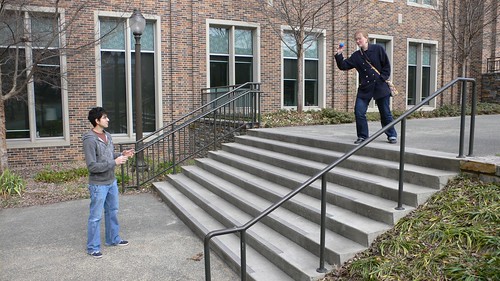
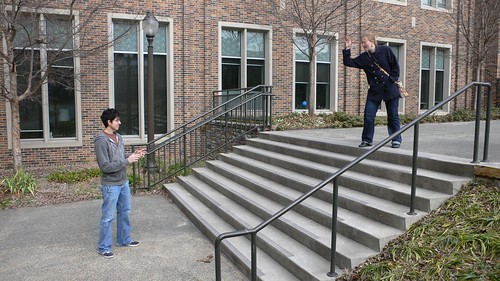
Also related, Sunday afternoon at 1.30p during the Activites Fair on the main staircases of Parrish Hall we’re going to be holding a Stairball demonstration. I’ll be teaching the game to new players and explaining some of the techniques for improved play. Mike Rosenberg ’08, the best Stairballer I know (he certainly leads in our lifetime series) will be playing a game against me, and new players will be encouraged to try out the game. Also, I’ll be taking names for the ALASSCA mailing list and will be trying to set up the league for later this year and a weekly Stairball night. Anyone interested, whether you know how to play or not, is certainly encouraged to attend.
Sometime soon I’ll recount the story of the creation of Stairball, but first I have a couple of other word games to go through, including some patternfilling variants.
Patternfilling
I think that, since the semester is starting and there were some interesting developments this season, I should first endeavor to chronicle the games that came to fruition over the summer.
Patternfilling one of a few word disciplines that have resulted from me messing around with Lexpert, which could quite possibly be my favorite program in the world. I believe that the Lexpert project started as a Scrabble player’s tool, but it also contains tools that can assist the crossword player, cryptogram cracker, and general wordplay enthusiast. (It was a real boon in solving the Confounded Compounds!)
The inspiration for the concept of patternfilling actually came from a game of Literati that Ron and I played a few months back. Across the second row from the top were two copies of the letter I, placed one space apart, through which he created the word RICIN. It got me wondering — how many similar words could have filled that slot? In particular I was looking for five-letter words because of the restrictions on the board. Thom and I searched for a little bit at his apartment the next day, lounging about, listening to Regina Spektor, and trying to fill the pattern ?I?I?. Ricin, limit, timid, vivid, civic, … I think we wound up with sixteen or seventeen. When I got home I finally had the genius idea to put it through Lexpert, which claims fifty-five matches for the pattern.
Then I started playing around. ?O?O? gave sixty-six returns. S???K — fifty-six. Interesting words, too, like BORON and SMOCK. I had an idea for how to make it a real exercise. I wanted to keep the atmosphere of people lounging around and thinking up the words, but a strict back-and-forth isn’t feasible because one person will inevitably run out before the other one does. Yet a free-for-all like Thom and I had isn’t really good either because whoever has more words off the top of their head will be favored in that case.
The middle ground I hit upon was first played with Nelson, Karen, and I. Players give words in turn, but only have 40 seconds (45? 60? We usually play 45 or 50 seconds when playing by IM, because timekeeping and typing is time-consuming) to come up with their word. Once a player gives a word that fits the pattern, the next person’s time begins. Once every player fails to come up with a word in succession, the group has one turn left to come up with a word to kick-start the rotation again. If the group time expires without a word, the round is over. (As I type this, I wonder if it would be better that, once everyone fails, it becomes a total free-for-all. That is, once the final player’s turn has ended without a word, there’s a 40 second clock that ticks down to the end of the round, and once anyone says a word that clock resets, but there’s no more turn structure. I bet we’ll play this way from now on.)
The first time we played we discovered an issue — if the final letter is a wildcard, invariably thousands of plurals are admitted. But the point wasn’t to find cheap words that end in S. We’re supposed to be looking for cool words like RICIN and SWANK! So more complicated syntax has since arisen, to help avoid the problem of cheap words and to promote more exotic patterns. Here’s the syntax I’ve used for explaining patterns:
- ? : Single wildcard. So ????K would denote all five-letter words ending in K.
- * : Variable-length wildcard. *K denotes every word that ends in K (of any length).
- V : Vowel wildcard. When handwritten, this should be the capital letter V in a circle. V cannot stand for Y. ???VK is words that end in vowel-K, like CHEEK and BREAK.
- X () : User-defined wildcard. When handwritten, this should be the capital letter X in a circle. X can stand for whatever is specified within the parenthesis. To create the pattern for words that end in vowel-K or -yk, write ???XK (aeiouy).
- +[?] : Must contain [?]. ????K +A denotes five-letter words ending in K containing A.
- -[?] : Cannot contain [?] ????K -E denotes five-letter words ending in K without E.
Patterns usually will contain a couple of these elements; often to get around the issue of plurals that we discovered in our first game we’ll add the restriction -*S to remove all words that end in S from the list. (Perhaps a -P wildcard could be invented to remove plurals but keep other words that end in S that are legit like abyss?) The ideal number of words on the list to wind up with is between 45-75 for two players and 65-100 for three players. We’ve yet to patternfill with four people, but conceivably you could play the game with as many people as you’d like.
There is one other, perhaps glaring problem with this game, and that is that it’s Lexpert-dependent and can’t be played without the program. There’s not much I can say to defend it: it is Lexpert-dependent. Lisa suggested that perhaps I should put some lists together, edit out the obscure words (what is LIPIN, and what is it doing in my ?I?I? list?), and create a Flash game, and that’s actually an excellent idea… if there’s enough lists to make it worthwhile. The other issue I see is that doing an exercise like this will group the words that fit the pattern together in one’s mind, so I bet that a player’s score will increase markedly when presented with the same pattern multiple times. This means that the game has practically no replay value (to me).
I’ve left a few patterns for the reader here. If you’re filling them by yourself, in parenthesis are goal numbers of words to try to come up with. If you get more than the goal number, you’re doing pretty well. For solo play, I don’t think a time limit should be observed.
S???K (33) solutions
??F?? -*S (19) solutions
???VY +A (18) solutions
“Cornhole” enthusiasts covered on BoingBoing
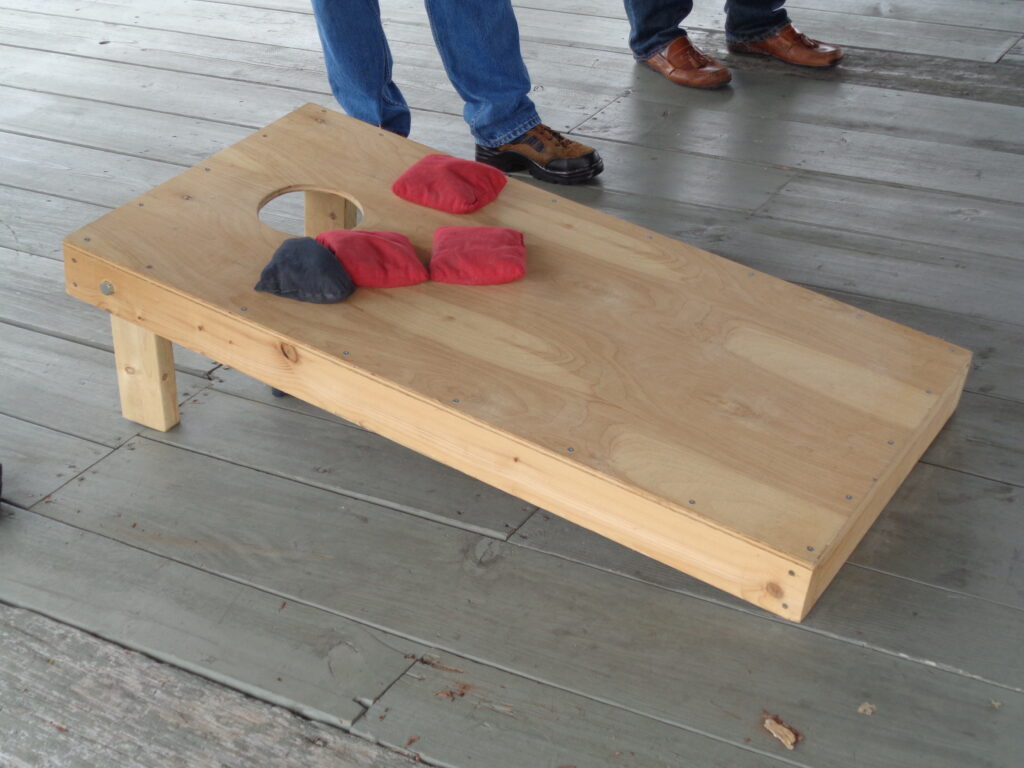
While I don’t have time to blog all the cool things that we’ve been up to recently, I simply must mention this excellent BoingBoing article, Hey boys and girls, let’s play “cornhole”!. It seems to focus largely on the silly name, but there is obvious interest in sports/games besides basketball/football etc… Perhaps someday we can get BoingBoing’d for stairball ^_^
Word substitutions
I don’t know if this really qualifies as a game, but it certainly sounds like fun…. if you’re slightly tipsy or sleep-deprived and have a bunch of textbooks lying around
So, the game is: When reading a certain sort of social criticism, it will be vastly improved with the following word substitutions:
gay –> ninja
lesbian –> pirate
bisexual –> monkey
transgendered –>robot
sexuality –>mojo
Stonewall –> the Meiji revolution
Freud’s work –> the battle of Seki GaharaSuch that you get things like:
“Anita Bryant’s anti-ninja “Save the Children” campaign is making a comeback.”
“In the 70′s, ninjas and pirates were completely demonized.”
“In fact, Bush went out of his way during the campaign not to offend the ninjas.”
“Thus we can see the sum total of the ninja agenda involves foisting more government on society and more intervention in free enterprise ”
“Ninja acts are sins, not crimes like murder and theft, and should be neither punished nor subsidized by the law.”
Or as comma suggests, “Kinsey’s work suggested that most people are at least somewhat monkeys.”
Surely you could come up with your own interesting word substitutions in other fields, such as plasma physics or evolutionary biology. This game will probably appeal most to geeks and college students who wish to see their studies in a new light… however, it may prove dangerous since whenever somebody makes a perfectly normal statement in class, you might remember the word substitutions and bust out in uncontrollable laughter. Trust me, that sort of thing happened to me all the time in high school.